
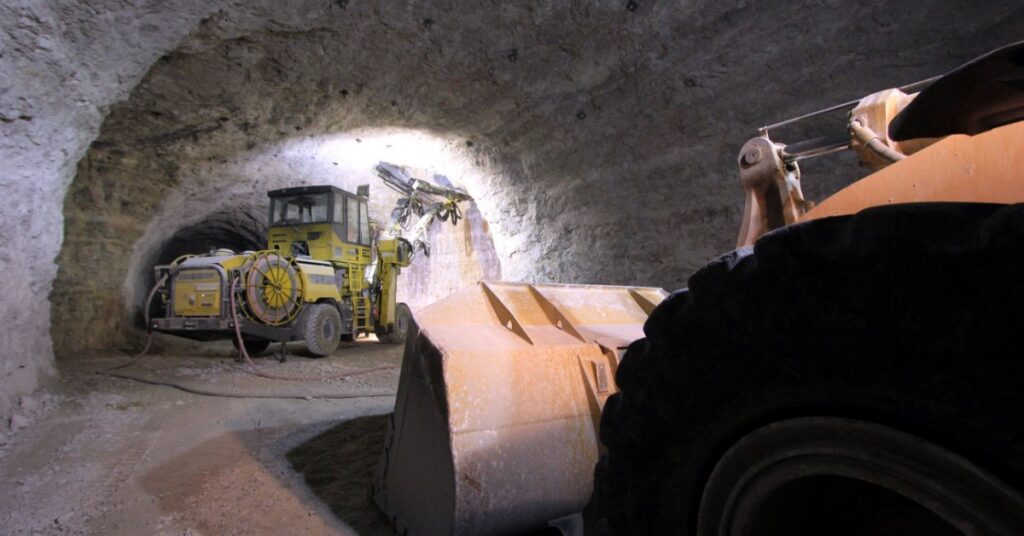
Mining drivelines work under heavy loads in tight underground headings. Every shaft rotates as the transmission sends power toward the axle. Small dimensional errors turn normal rotation into vibration or uneven component loading. Across these machines, precision engineering improves driveline performance by controlling the mechanical relationships that determine how smoothly power moves through the powertrain.
1. Precision Balancing Limits Rotational Vibration
A driveshaft rotates around a centerline at speeds that place substantial force on any uneven mass. Extra weight on one side of the assembly pulls outward with every revolution and creates a repeating vibration. The resulting movement travels into universal joints and support bearings where it adds loads beyond their engineered distribution.
Precision balancing identifies uneven mass around the shaft. Technicians then adjust weight distribution so that the assembly rotates with less centrifugal force acting away from its centerline. Repeated hauling and tramming cycles keep mining drivelines under changing torque throughout a shift. A balanced shaft transfers torque with less vibration reaching supports or connected powertrain components.
2. Controlled Runout Keeps Rotation Concentric
Balance alone doesn’t prove a driveshaft rotates on a true centerline. Runout measures how far a rotating surface moves away from its intended axis. Bent tubing or an improperly seated flange produces runout even when the assembly has the right overall mass distribution. As a result, each revolution causes the shaft to move laterally.
Accurate fabrication controls tube straightness and keeps yokes aligned with the shaft centerline. During servicing, technicians verify runout with a dial indicator before balancing the complete assembly. The sequence separates geometric error from mass imbalance instead of treating every vibration as the same problem. Controlled runout supports smooth rotation and limits cyclic movement through the universal joints.
3. Matched Operating Angles Control Speed Fluctuation
Universal joints let a driveshaft transmit torque between components that don’t share one straight centerline. As a single Cardan joint operates at an angle, its output speed changes slightly through each revolution. A second joint counters the variation when engineers establish compatible angles at both ends of the shaft.
Precision engineering uses transmission position and axle position to calculate the working angles across the driveline. The shaft length and mounting method preserve those relationships through the intended operating range.
Underground equipment adds another concern because machine load or axle movement changes the shaft angle. Engineers account for those positions so angular differences don’t produce unnecessary torsional vibration. Manufacturer guidance ties allowable joint angle to shaft speed and treats opposing angle relationships as a central driveline design factor.

4. Accurate Phasing Stabilizes U-Joint Motion
Two universal joints depend on more than their individual operating angles. The yokes must remain in the intended rotational relationship so speed variation from one joint works with the motion of the other. Incorrect phasing disrupts this relationship and introduces a repeating change in rotational velocity. The resulting vibration follows shaft speed instead of appearing as a random machine shake.
Exact spline indexing and yoke orientation preserve the intended phase across the shaft. Repair work must retain those positions after technicians separate the slip section or replace driveline components. Mining equipment puts substantial torque through these connections, making a phasing error especially noticeable. By refining the driveline’s design, joint motion remains in sync as power moves toward the axle.
5. Torque-Matched Components Manage Mining Loads
A shaft assembly must carry forces through the tube and universal joints without pushing individual components beyond design limits. Precision engineering matches driveline series and component capacity to the torque demands of the machine.
Before selecting joint size or shaft construction, engineers evaluate available power and drivetrain ratios. They account for transient loading that places extra stress on the driveline outside steady travel conditions. A properly matched assembly spreads torque through components sized around the same application demand. Consistent capacity across the assembly avoids weak links and prevents excessive stress from concentrating at one joint or connection.
6. Shaft Dimensions Control Critical Speed
Every driveshaft has a rotational speed range where bending vibration rises sharply. Critical speed depends partly on shaft length or tube diameter. Unsuitable dimensions move a long shaft closer to resonance even after technicians balance the assembly. Severe vibration develops as driveshaft speed approaches the unstable range.
Precision engineering compares expected driveshaft speed against the geometry of the complete assembly. Designers adjust tube diameter or shaft length to move critical speed away from normal operating revolutions per minute. Multipiece layouts provide another option when a single long shaft creates an unsuitable speed relationship. This calculation supports stable rotation in mining equipment.

7. Precise Spline Fit Limits Radial Movement
Slip splines let a driveline change length as connected components move relative to one another. The splined surfaces slide axially and maintain enough engagement to transfer torque. Excess radial clearance lets the shaft shift away from its centerline and introduces vibration under rotation. Loose spline engagement causes abrupt torque changes at the slip connection.
Careful machining controls the relationship between the yoke shaft and spline sleeve. A matched fit supports smooth sliding motion without excessive looseness between the mating teeth. Mining drivelines gain particular value from this precision because axle movement occurs under heavy load. Accurate spline geometry protects alignment and preserves the axial movement the driveline design accommodates.
8. Precise Weld Alignment Preserves Shaft Centerline
A driveshaft tube depends on welded connections that join the center section to its yokes or other end fittings. Heat input and fixture error shift those parts away from the intended centerline when fabrication control slips. Even a small geometric change adds runout before the shaft reaches the balancing stage.
Precision welding begins with accurate component positioning and stable fixturing. Technicians then inspect finished assembly dimensions to verify alignment before balance work. Certain production welding methods target lower runout or lower initial imbalance at the tube connection. Treating welding as part of the shaft’s composition protects the centerline from one end of the assembly to the other. Underground mining equipment gains a straight rotating structure that carries heavy torque with less avoidable vibration from fabrication error.
Protect Mining Drivelines With Precise Improvements
Mining driveline performance depends on how accurately each rotating component works with the rest of the assembly. Precision engineering improves driveline performance because it controls geometry and mass distribution before torque reaches demanding underground conditions. Those details become especially useful after a machine modification or shaft repair changes the original driveline relationship.
Bull Powertrain offers driveline services ranging from individual components to installing complete assemblies for off-highway equipment. Our team can build a custom driveshaft around the machine’s operating requirements, ensuring that the equipment holds up during demanding conditions.